
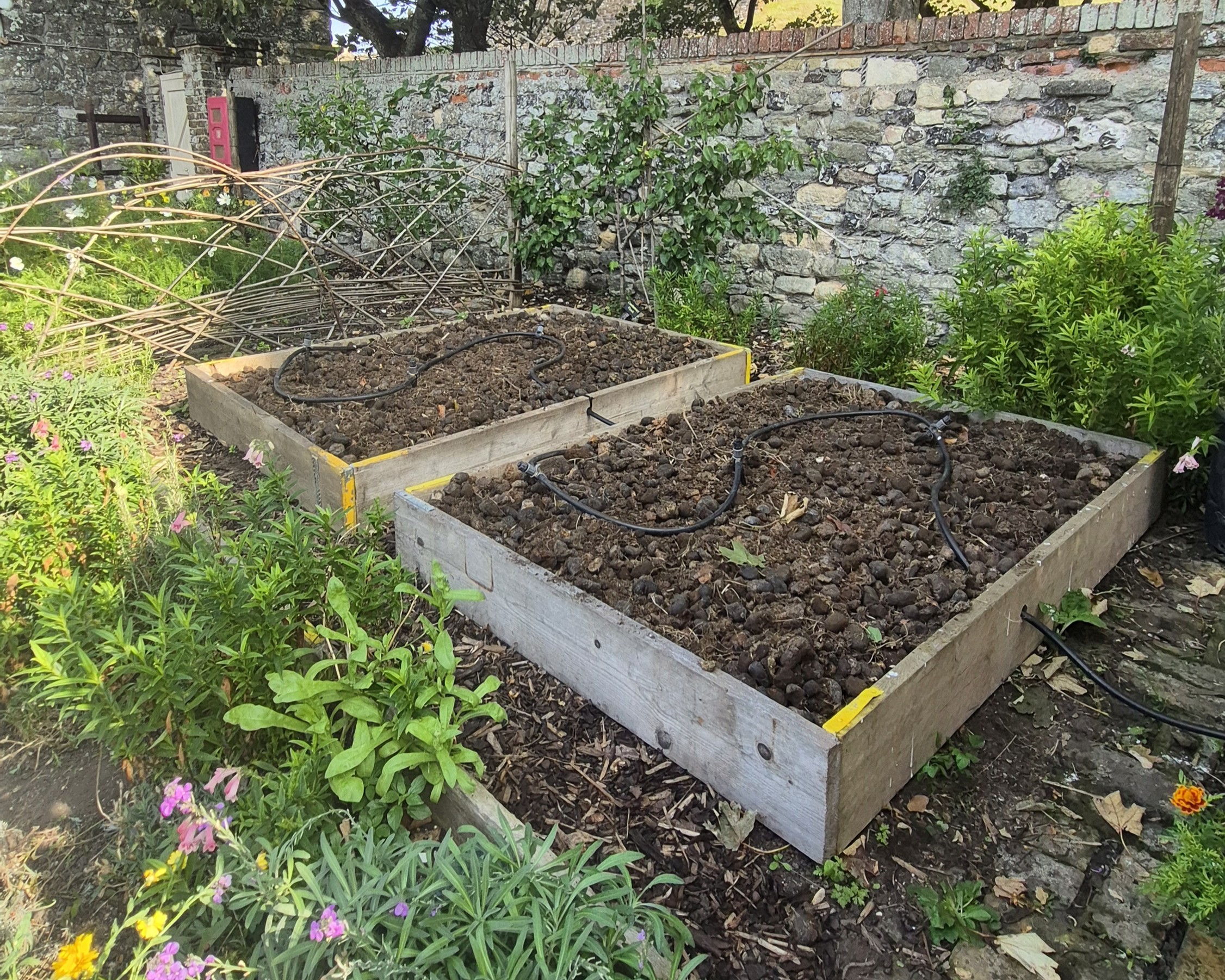
The Kitchen Gardener’s Winter Secret.
How We Are Prepping Our Raised Beds for Spring Using No-Dig.
Autumn has officially arrived, and while it looks like the garden is winding down for a long winter sleep, beneath the surface, the real work is just beginning. If you want to arrive at April with rich, crumbly, weed-free raised beds without spending your Spring breaking your back with a spade, now is the time to act.
Over the next week or so, we are putting the brilliant, science-backed No-Dig method to work in our raised beds using three simple ingredients: field-collected horse manure, mulched sycamore leaves, and recycled black plastic sacks. Here is exactly why we are doing it, how it works, and how you can copy our setup at home.
The Perfect Partnership: Manure & Sycamore Leaves
In standard composting terminology, successful decomposition relies on balancing two components: “Greens” (high-nitrogen materials) and “Browns” (high-carbon materials). On their own, both of our autumn ingredients present a bit of a challenge:
- The Field Horse Manure: Highly nutritious but packed with dormant pasture weed seeds.
- The Sycamore Leaves: Excellent for building soil structure, but thick, leathery, and notoriously slow to rot down.
By bringing them together in October, they balance each other out beautifully. The nitrogen in the horse manure acts as a turbocharger for the slow-to-rot sycamore leaves, kickstarting the biological activity needed to break them down into dark, rich earth over the next six months.
Instead of manually digging these nutrients deep into the soil—which destroys delicate, beneficial networks of mycorrhizal fungi—we are feeding the soil from the top down. Over the winter, earthworms will feast on this surface layer, tunnelling up and down to naturally aerate and cultivate the soil for us.
Our 4-Step October Bed Prep
Because we are applying these raw materials directly to the beds rather than a traditional compost bin, we have to layer them strategically so the winter weather doesn’t ruin our hard work:
- The Base Layer: We started by spreading our field-collected horse manure directly onto the surface of the beds.
- The Blanket Layer: We topped the manure with a thick dressing of our mulched sycamore leaves. Shredding or mulching the leaves is a critical step; it increases their surface area so they break down exponentially faster.
- The Deep Soak: Once assembled, we gave the beds a thorough watering. This mats the light, papery leaves together so they stick to the damp manure beneath rather than blowing away in autumn gales.
- The Secret Weapon (The Black Sacks): Finally, we covered the entire raised bed with black plastic sacks, tucking the edges in tightly and weighing them down with bricks and logs.
Why the Black Sacks Are a Total Game-Changer
Covering the beds from October to April transforms each raised bed into its own micro-compost chamber. The black plastic serves four critical functions:
- Wind & Weather Protection: It locks the shredded leaves securely in place.
- Heat Absorption: The black surface absorbs weak winter sunlight, raising the soil temperature by a few crucial degrees to keep earthworms and microbes active deep into the winter.
- Moisture Lock: It creates a closed vapor loop, trapping rising moisture so the leaves never dry out and stall the rotting process.
- Natural Weed Elimination: This is known as occultation. The cosy environment triggers the weed seeds in the pasture manure to sprout, but because the black plastic completely blocks out all light, the seedlings instantly die off.